MOBILE

Caries Risk Assessment and Care Pathways

Recommendations

Foundational Articles

American Academy of Pediatric Dentistry. Caries risk assessment and management for infants, children, and adolescents, 2021. http://www.aapd.org/media/Policies_Guidelines/BP_CariesRiskAssessment.pdf. Christian B, Armstrong R, Calache H, et al. A systematic review to assess the methodological quality of studies on measurement properties for caries risk assessment tools for young children. Int J Paediatr Dent 2019:29:106-116.

Featherstone JDB, Chaffee BW. The evidence for caries management by risk assessment (CAMBRA). Adv Dent Res 2018;29: 9-14.

Fontana M. The clinical, environmental, and behavioral factors that foster early childhood caries: Evidence for caries risk assessment. Pediatric Dent 2015;37(3):217-225.

Scottish Intercollegiate Guidelines Network. SIGN 138: Dental interventions to prevent caries in children, March, 2014. https://www.sign.ac.uk/assets/sign138.pdf.

Senneby A, Jejar I, Sahlin N-L, Svensater G. Diagnostic accuracy of different caries risk assessment methods. A systematic review. J Dentistry 2015(43:1385-1393.

Slayton R, Araujo M, Guzman-Armstrong S, Espinoza L, et al. Evidence-based clinical practice guideline for nonrestorative management of dental caries. J Am Dent Assoc 149 (10):837-849, 2018.

Weyant RJ, Tracy SL, Anselmo T, Beltran-Aguilar ED, et al. Topical fluoride for caries prevention: Executive summary of the updated clinical recommendations and supporting systematic review. J Am Dent Assoc 2013;144(11):1279-91

Background

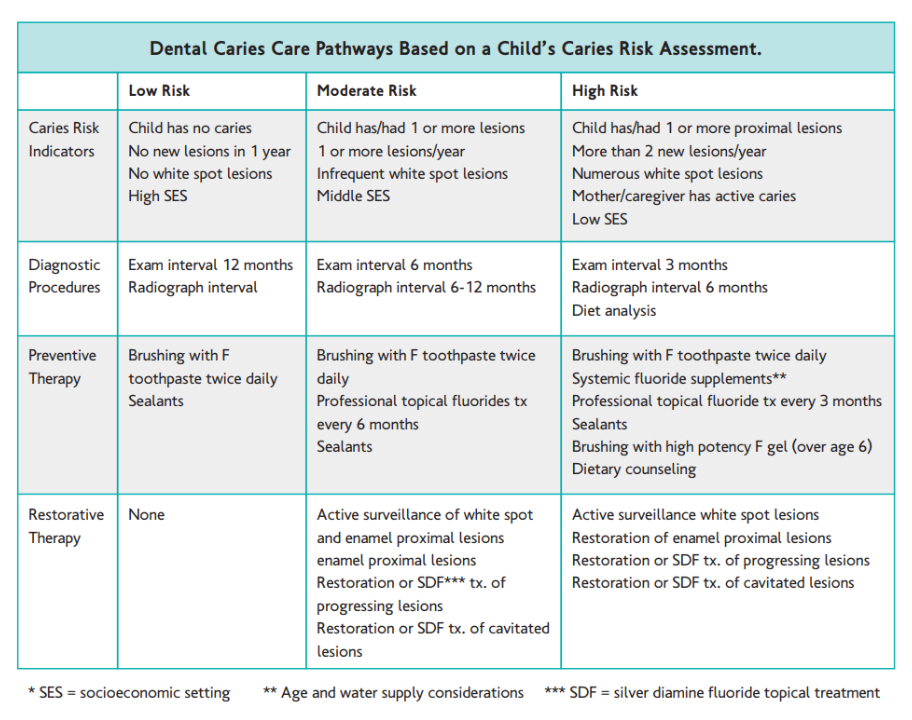
The goal of caries risk assessment is to deliver preventive and restorative care optimized to a specific individual patient. Presently, however, few studies so far have determined how the application of caries risk assessment affects individual dental health outcomes. Dental caries care pathways are based on an understanding of risk factors as applied Background to a specific child. Children at high caries risk require intense prevention to prevent caries initiation and arrest caries progression. Care pathways also assume that there will be little benefit of advanced preventive therapies for those children who are at low risk for dental caries (see Table for care pathways).

IAPD Recommendations

  1. Important caries risk factors are the presence of enamel defects, previous caries experience and the longitudinal evaluation of lesion progression (increased dimension/ cavitation of white spot lesions or presence of new lesions) at recall visits. Consensus-based recommendation > Global agreement 100%

  2. Other useful caries risk factors in children are: whether the mother/caregiver has active caries, the socioeconomic status of the family, and whether the child consumes fermentable carbohydrates at high frequency (see Table for caries risk indicators). Consensus-based recommendation > Global agreement 94%

  3. Besides determining caries risk at initiation of therapy, and ongoing assessment of a changes in risk factors over time allows for refinement of caries management. Consensus-based recommendation > Global agreement 100%

  4. The term “active surveillance” is used to denote instituting caries preventive measures and careful monitoring of caries arrestment or progression. Consensus-based statement > Global agreement 94%

  5. Along with other information, the likelihood of a patient returning for periodic recalls and compliance with preventive therapy, is important for considering active surveillance strategies. Consensus-based statement > Global agreement 100%

Other Recommendations